Weekly review · 25 October 2026
CELESTE: from a web patch to FPGA audio
Stereo Line-In, parallel effects and shared control across web, encoders and HDMI.
Decisions and development
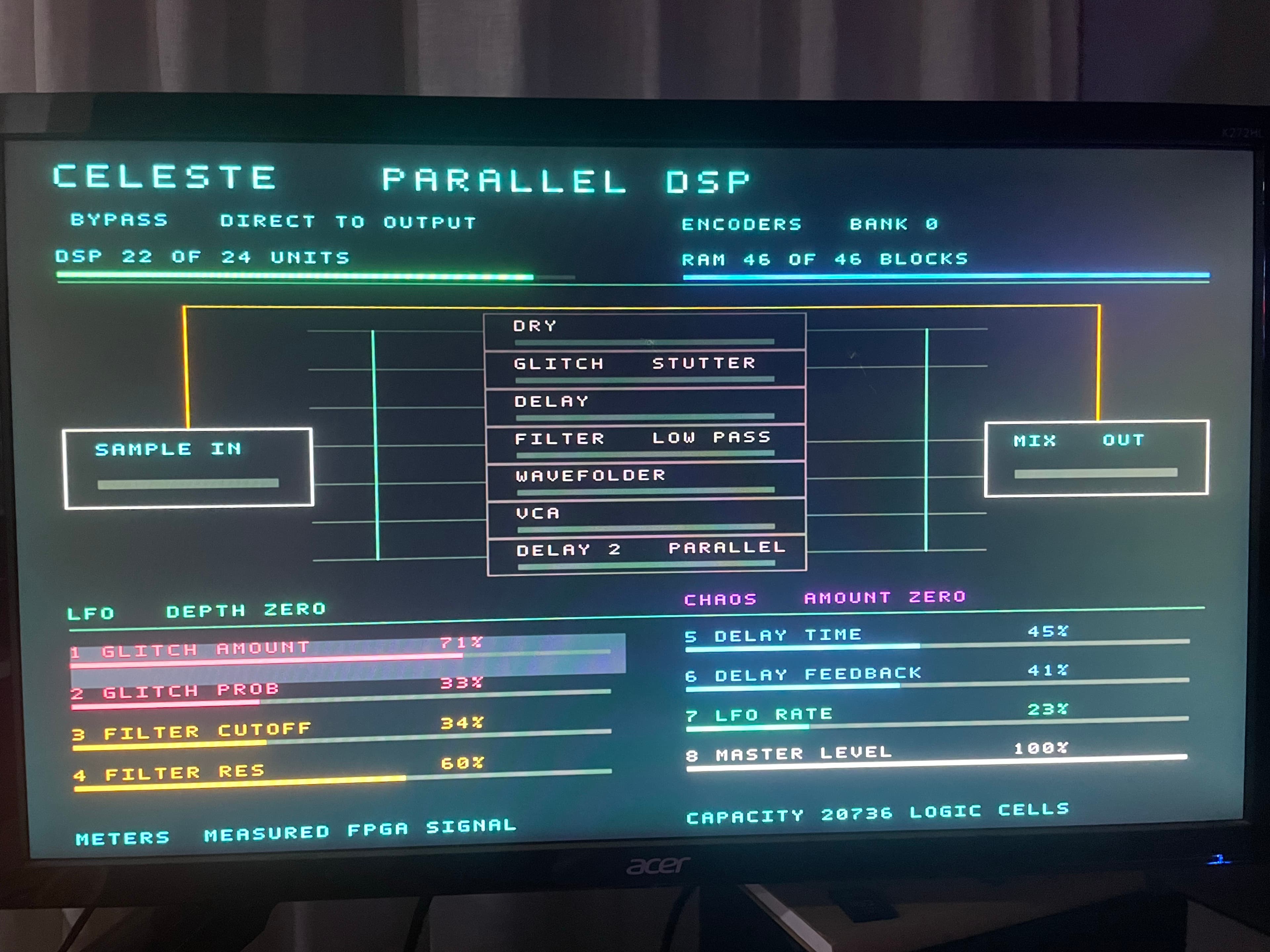
The current firmware receives PCM1808 audio, processes it on Tang Nano 20K and outputs through PCM5102 at 48 kHz. The web controls routing, presets, bypass, mute and solo; 16 controls across two banks match the encoders and HDMI value column. USB carries control and telemetry, not music.
Glitch, two delays, four filter modes, Wavefolder and VCA join Chorus, Flanger, Crusher, Freeze, Tremolo and Auto-pan. LFO, Chaos and Envelope provide modulation. Branches are concurrent physical blocks; adding duplicate effects requires resources and synthesis. Usage: 19,384/20,736 cells, 38/46 RAM blocks and 23/24 DSP.
Parallel Tides extends DEMO LIVE to 4:34, 168 BPM and 12 scenes. PC audio feeds Line-In while the web automates FPGA combinations. Tang Control adds 44 DAW-automatable parameters. These images and video document the earlier revision; the video uses original music, not a recording of FPGA-processed audio.
- Tang Nano 20K
- PCM1808 / PCM5102
- Web Serial
- Tang Control